
UNIFIED HIGHER EDUCATION QUALITY STANDARD
A Coherent, Regionally Grounded, Globally Informed Framework for Institutional Excellence Across the Gulf Region
Coherence
Across teaching, research, governance and engagement
Institutional Maturity
Balanced progress across interconnected quality dimensions
Alignment
With national development strategies and regional transformation agendas
Public Trust
Through transparent, principled and ethical institutional practice
Future Ready
Foundation for indicator development and voluntary benchmarking
Introduction and Context
The purpose of the Unified Higher Education Quality Standard is to establish a coherent, regionally grounded, and globally informed framework for quality assurance in higher education that articulates the essential dimensions of institutional quality within the Gulf higher education sector.
The Standard provides a shared architecture through which institutions may evaluate, strengthen, and align their academic, research, governance, and engagement practices in a structured and integrated manner.
The Unified Standard is therefore positioned as a developmental and collaborative framework rather than a regulatory instrument. Its purpose is not to replace national quality systems or international accreditation schemes, but to complement them by providing a regionally anchored model of excellence that supports long-term institutional resilience, innovation, and impact.
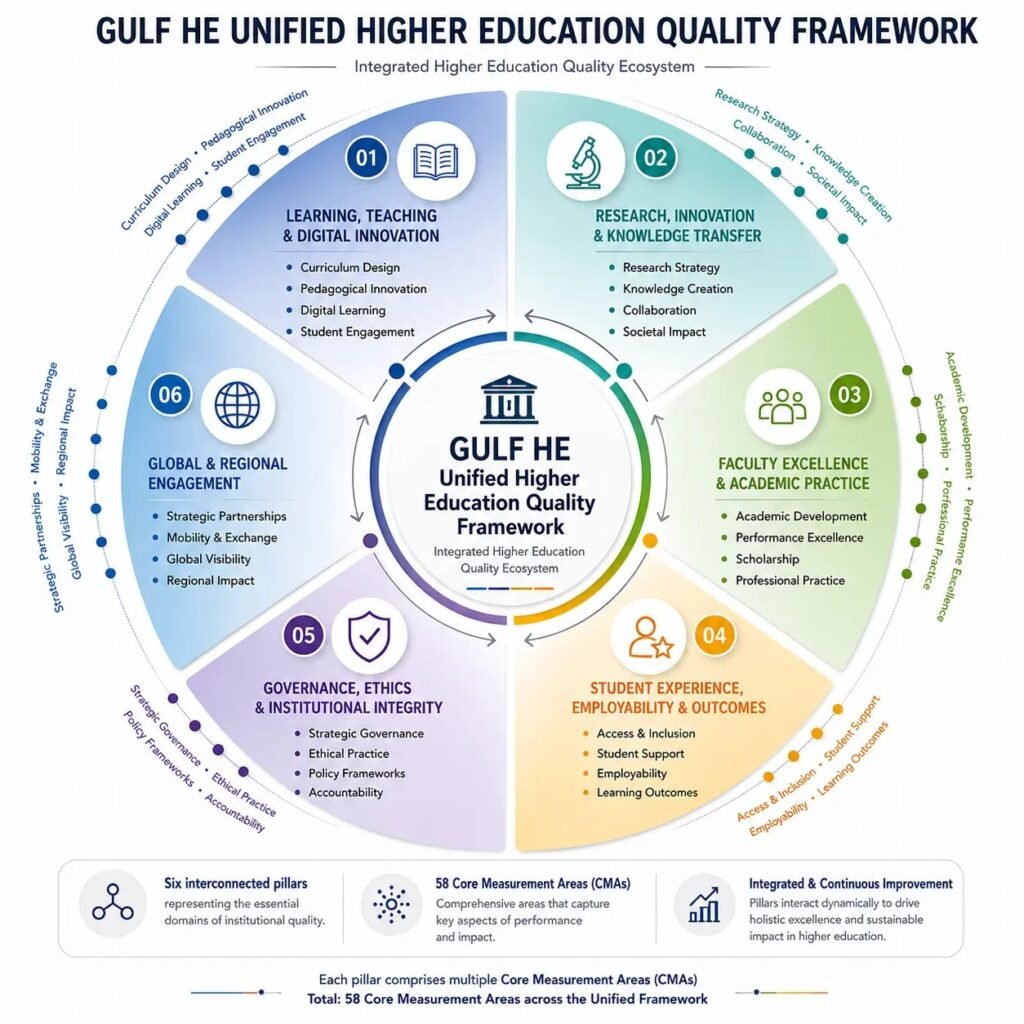
This foundational release focuses on conceptual clarity and shared language. It introduces the Six Pillars of Institutional Quality and their associated Core Measurement Areas (CMAs), offering institutions a developmental framework for strategic reflection and internal alignment.
Through this framework, we seek to foster a culture of continuous enhancement, ethical responsibility, and collective advancement across the higher education landscape of the Gulf region.
Regional Higher Education Landscape
The Gulf higher education landscape is marked by rapid expansion, strategic reform, and global integration. Institutions are diverse in mission, scale, and governance, operating within varied regulatory environments.
Key Trends Shaping The Region
Digital transformation and technological integration, including Al, learning analytics, and hybrid learning.
Economic diversification with focus on employability, entrepreneurship, industry alignment, and applied research.
Internationalisation through mobility, partnerships, dual degrees, and transnational collaboration.
Regulatory evolution with strengthened quality assurance and increased performance scrutiny.
Societal expectations for inclusion, sustainability, ethics, and measurable impact.
Conceptual Architecture of the Unified Standard
The Six-Pillar Quality Ecosystem
The Unified Standard is structured around a Six-Pillar Quality Ecosystem. Institutional quality is the outcome of coherent and balanced performance across interdependent dimensions of academic and organisational life.
Rationale for a Unified Quality Framework
A unified framework addresses key challenges and seizes opportunities for the sector.
- Conceptual Fragmentation - Enables strategic alignment across domains.
- Regional Identity - Reflects shared Gulf context while remaining globally aligned.
- Balanced Development - Promotes advancement across academic, operational, and societal dimensions.
- Public Trust - Enhances accountability and confidence among stakeholders.
- Future Readiness - Anticipates technological, economic, and societal change.
The Unified Standard defines essential domains for systematic understanding and strengthening of institutional quality-not prescriptive thresholds.
By articulating the Six Pillars and CMAs, the framework supports long-term resilience, ethical leadership, and regional competitiveness.
The six pillars and their core measurement areas (CMAS)
Learning, Teaching & Digital Innovation Excellence
- Curriculum Design and Outcome Alignment
- Pedagogical Innovation and Teaching Quality
- Assessment Design, Feedback and Academic Integrity
- Digital Learning, Learning Analytics and AI Integration
- Teaching Effectiveness and Continuous Improvement
- Student Experience, Engagement and Partnership
- Learning Outcomes, Employability and Educational Impact
- Curriculum Agility, Review and Academic Governance
- Learning Resources and Teaching Infrastructure
- Inclusive, Ethical and Sustainable Curriculum Design
Research, Innovation & Knowledge Transfer
- Research Strategy and Alignment with Mission and National Visions
- Research Quality, Outputs and Scholarly Impact
- Interdisciplinary Research and Collaborative Practice
- Applied Research, Innovation and Societal Impact
- Knowledge Transfer, Commercialisation and Enterprise
- Research Capacity, Infrastructure and Ethical Oversight
- Open Science, Data Stewardship and Reproducibility
- Community, Industry and Policy Engagement
- Research Culture, Integrity and Inclusion
- Environmental and Societal Impact Assessment
Faculty Excellence & Academic Practice
- Faculty Qualifications, Credentials and Professional Standing
- Continuous Professional Development and Academic Growth
- Teaching Effectiveness, Peer Review and Feedback Integration
- Research, Scholarship and Innovation Contribution
- Academic Advising, Supervision and Student Success
- Faculty Engagement, Collegiality and Institutional Service
- Recognition, Promotion and Reward Frameworks
- Diversity, Equity and Inclusion within the Faculty Body
- Workload Management, Well-being and Sustainability
Student Experience, Employability & Outcomes
- Access, Admissions and Widening Participation
- Orientation, Transition and First-Year Experience
- Learning Support, Engagement and Academic Success
- Student Well-being, Safeguarding and Mental Health
- Inclusion, Belonging and Campus Climate
- Employability, Career Readiness and Employer Engagement
- Entrepreneurship, Innovation and Enterprise Culture
- Student Voice, Partnership and Co-Creation
- Graduate Outcomes, Tracer Studies and Progression
- Co-curricular Learning and Community Engagement
Governance, Ethics & Institutional Integrity
- Governance Structures, Roles and Accountability
- Strategic Planning, Performance Monitoring and Risk Management
- Policy Frameworks and Regulatory Compliance
- Ethical Leadership, Institutional Culture and Decision-Making
- Academic Integrity, Misconduct Prevention and Enforcement
- Equity, Fairness and Non-Discrimination
- Data Governance, Privacy and Responsible Artificial Intelligence
- Transparency, Public Reporting and Stakeholder Accountability
- Financial Sustainability, Stewardship and Ethical Investment
- Institutional Resilience, Crisis Preparedness and Infrastructure
Global & Regional Engagement
- Regional Collaboration and Gulf Identity
- International Partnerships and Academic Networks
- Student and Faculty Mobility and Exchange
- Cross-Border Industry and Employer Partnerships
- Global Visibility, Reputation and Knowledge Export
- Bilingual Scholarship and Intercultural Learning
- Transnational Education Governance and Quality Assurance
- Alumni Relations and Global Impact
- Contribution to Regional Development Agendas and SDGs
Begin the Framework Journey.
Discover how the Unified Higher Education Quality Standard can support your institution in strengthening quality, advancing institutional excellence, and building long-term strategic resilience. Whether you are seeking an introduction to the Six-Pillar Quality Ecosystem or exploring future benchmarking and development opportunities, our team is here to support your journey toward sustainable institutional impact and continuous enhancement.