

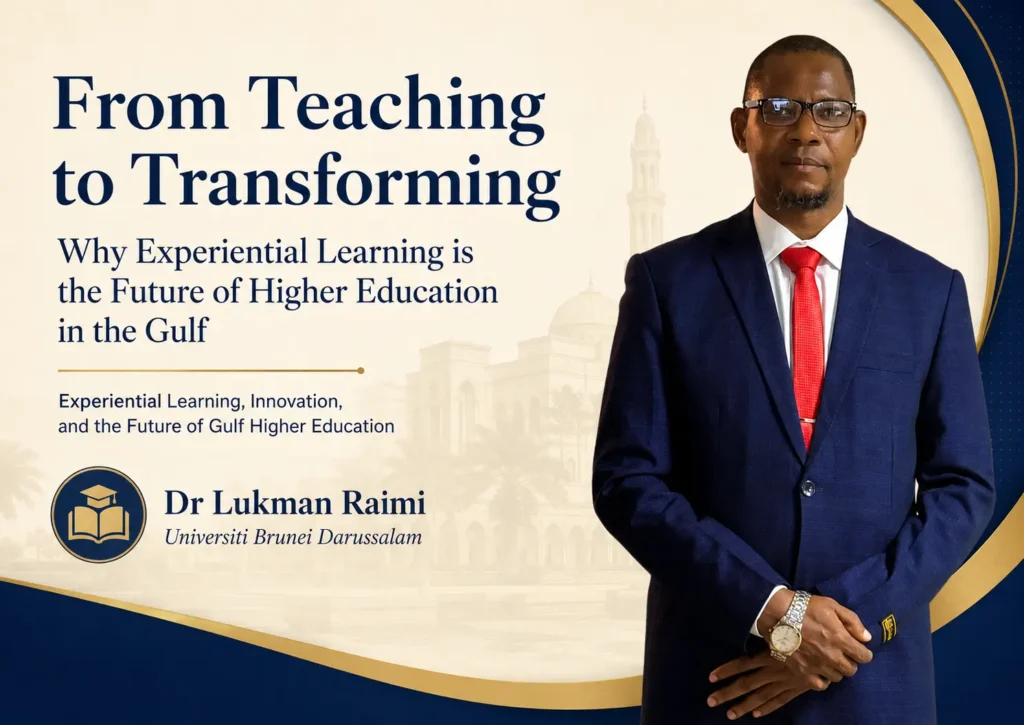
Higher education is experiencing one of the most significant periods of transformation in recent decades. Rapid technological advancement, artificial intelligence, shifting labour market expectations and the learning preferences of Generation Z students are all prompting universities to reconsider how learning is designed and delivered.
In the Gulf region, this transformation carries particular importance. Universities are increasingly expected not only to provide knowledge, but also to develop graduates who are innovative, adaptable, entrepreneurial and capable of addressing complex real-world challenges. This raises an important question for educators and academic leaders:
Are traditional lecture-based approaches sufficient to prepare students for the future?
Increasingly, the answer appears to be no.
Moving Beyond Passive Learning
Traditional teaching models have long played an important role in higher education. Lectures can provide structure, introduce key concepts and support knowledge transmission. However, when learning remains largely passive, students may struggle to connect theory with practice.
This is especially important in today’s higher education environment. Graduates are entering workplaces that require more than subject knowledge. They need to think critically, communicate clearly, collaborate effectively, solve problems creatively and adapt to change. These capabilities are not developed through content delivery alone. They require active engagement, reflection and application.
This is where experiential learning becomes essential.
What Is Experiential Learning?
Experiential learning is rooted in David Kolb’s Experiential Learning Theory, which views knowledge as something created through the transformation of experience. In simple terms, students learn by doing, reflecting, experimenting and applying ideas to real-world contexts.
Rather than positioning students as passive recipients of information, experiential learning places them at the centre of the learning process. It engages the whole learner across three important domains:
Cognitive — thinking, analysing and problem-solving.
Affective — valuing, reflecting and developing attitudes.
Psychomotor — doing, creating and practising skills.
This makes experiential learning a powerful approach because it supports deeper understanding, stronger retention and greater student motivation. Students are not simply asked to remember concepts. They are invited to use them.
Why Experiential Learning Matters in Gulf Higher Education
The Gulf region is investing heavily in knowledge-based economies, innovation, entrepreneurship, sustainability and digital transformation. These priorities require graduates who can move confidently between theory and practice.
Experiential learning aligns strongly with these regional ambitions.
Students today want learning experiences that feel meaningful and relevant. They want to understand how classroom knowledge connects to the workplace, society and their future careers. Employers, at the same time, are looking for graduates who can demonstrate practical skills such as critical thinking, teamwork, creativity, communication, leadership and problem-solving.
Experiential learning provides a direct pathway for developing these capabilities. It helps students practise the kinds of thinking and action they will need beyond the classroom.
Practical Ways to Integrate Experiential Learning
One of the strengths of experiential learning is that it does not require a complete redesign of academic programmes. It can be introduced into existing modules and courses through a range of practical teaching strategies.
Examples include:
Case studies, where students analyse real or realistic organisational problems.
Simulations, where students practise decision-making in controlled but authentic scenarios.
Debates, where students examine issues from multiple perspectives.
Study groups, where collaborative learning and peer explanation are encouraged.
Field research, where students collect and analyse information outside the classroom.
Design thinking exercises, where students identify problems and develop user-centred solutions.
Service-learning projects, where academic learning is connected to community engagement.
Role plays, where students practise communication, negotiation or leadership scenarios.
Business pitches, where students present ideas to panels or peers.
Prototyping, where students design, test and improve solutions.
Guest mentoring, where industry and community experts support student learning.
Student-led initiatives, where learners take responsibility for planning and implementation.
These approaches transform students from passive listeners into active participants in their own learning journey.
Service Learning: Connecting Knowledge with Community
One particularly effective form of experiential learning is service learning. In service-learning activities, students work with communities, organisations or social groups to address real issues while developing academic, personal and professional skills.
This approach benefits both students and communities. Students gain a deeper understanding of social realities, develop empathy and learn how to apply knowledge responsibly. Communities, in turn, benefit from student engagement, fresh ideas and practical support.
In the Gulf context, service learning can be especially valuable because it connects higher education with national priorities around community development, social responsibility, sustainability and civic engagement.
Prototyping: Building Innovation and Entrepreneurial Thinking
Another powerful example is prototyping. Through prototyping, students design, test, refine and improve solutions to real-world problems. This approach is particularly useful in entrepreneurship, business, engineering, design, technology and innovation-related courses.
Prototyping encourages students to experiment. It helps them understand that learning often involves trial, feedback and improvement. It also builds resilience because students learn that early ideas may not work perfectly, and that failure can become part of the learning process.
This kind of activity directly supports creativity, innovation and entrepreneurial capability, all of which are central to the future of higher education in the Gulf.
The Changing Role of the Educator
As experiential learning becomes more important, the role of the educator is also changing.
Educators are no longer only sources of knowledge. They are becoming facilitators, coaches, mentors and designers of meaningful learning experiences. Their role is to create the conditions in which students can inquire, test ideas, collaborate, reflect and grow.
This does not reduce the importance of the educator. In fact, it makes the educator’s role more sophisticated. Designing experiential learning requires careful planning, clear outcomes, structured reflection and meaningful assessment. It also requires educators to support students as they navigate uncertainty and complexity.
The future of teaching is therefore not simply about delivering more content. It is about creating learning experiences that transform how students think, act and contribute.
From Teaching to Transformation
The challenge for higher education is clear. Universities must move from simply teaching students what to think towards helping students learn how to think, create, collaborate and solve problems.
Experiential learning provides a practical and powerful way to achieve this shift. It supports deeper engagement, strengthens employability skills and prepares students to contribute meaningfully to knowledge-driven economies.
For the Gulf region, where universities are closely connected to national visions for innovation, entrepreneurship, sustainability and human capital development, experiential learning is not an optional teaching trend. It is a strategic necessity.
The future of higher education will belong to institutions that can create learning experiences that are active, relevant, reflective and transformative.
Experiential learning offers a clear pathway towards that future.
About the Author
Dr Lukman Raimi, PhD, LL.M., FCEnt, FIMC, CMC
Universiti Brunei Darussalam
Dr Lukman Raimi is an Assistant Professor of Entrepreneurship and Programme Leader for Business Administration and Entrepreneurship at Universiti Brunei Darussalam. His research focuses on entrepreneurship, governance, institutional quality, labour markets and sustainable economic development, with particular emphasis on how regulatory and institutional frameworks shape entrepreneurial ecosystems and economic performance.