

Critical thinking is often described as one of the most important outcomes of higher education. It appears in programme learning outcomes, assessment rubrics, accreditation documents and graduate attributes. Yet in the classroom, critical thinking can sometimes remain difficult to teach in a structured and practical way.
Students may be encouraged to “think critically”, “analyse the issue” or “justify their answer”, but they are not always shown how to move from initial understanding to deeper questioning, judgement and decision-making. This is where a structured questioning model can be particularly valuable.
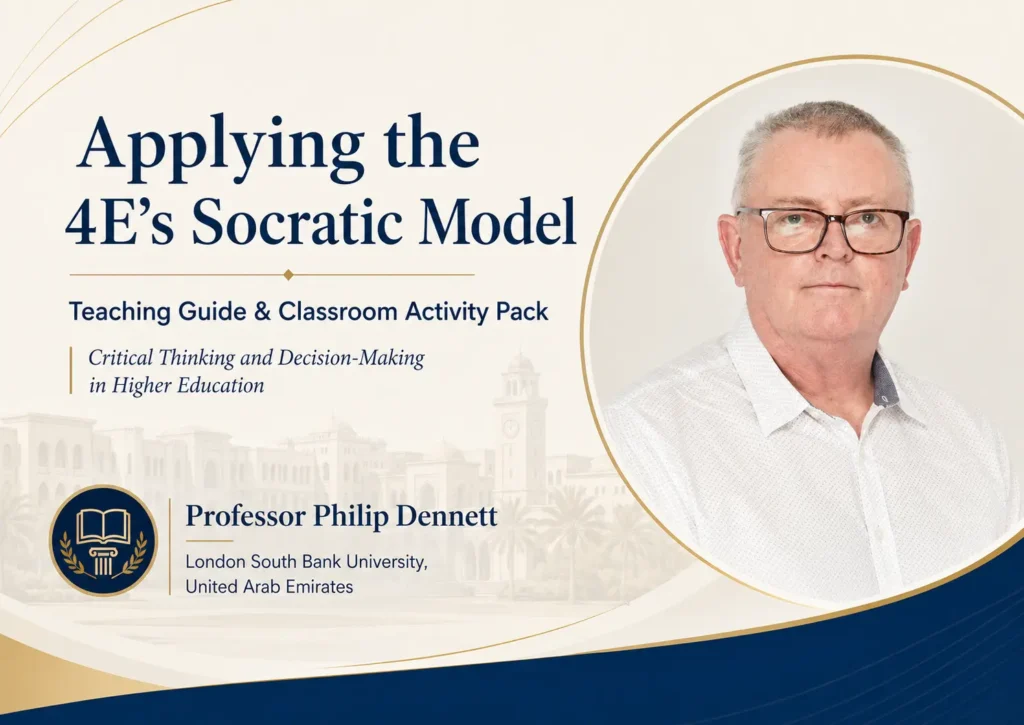
The 4E’s Socratic Model, developed by Professor Philip Dennett, provides a practical framework for guiding students through disciplined inquiry. It helps learners move from comprehension to action through four connected stages: Explore, Examine, Evaluate and Elect.
In the context of UAE higher education, where students are often preparing for complex professional, organisational and societal challenges, this model offers a useful classroom approach for developing critical thinking, reasoning and decision-making skills.
What Is the 4E’s Socratic Model?
The 4E’s Socratic Model organises critical inquiry into a clear sequence. It encourages students to move beyond surface-level answers and engage more carefully with the meaning, evidence, assumptions and consequences of a problem or statement.
The four stages are:
Explore — understanding the issue, identifying key terms and clarifying meaning.
Examine — applying structured questioning to analyse the issue from different angles.
Evaluate — weighing evidence, interpretations and implications.
Elect — making a justified decision or choosing a course of action.
The first three stages align closely with the higher-order thinking processes associated with Bloom’s taxonomy, particularly comprehension, analysis, synthesis and judgement. The final stage, Elect, is especially important because it ensures that critical thinking does not remain theoretical. Students must eventually decide, act, justify or recommend.
This makes the model particularly useful for university teaching, where the goal is not only to help students understand knowledge, but also to help them use knowledge responsibly.
Why This Model Matters for University Teaching
Many students can describe an issue, but fewer can systematically question it. Some can identify facts, but struggle to distinguish facts from interpretation. Others can offer opinions, but find it difficult to justify those opinions with evidence.
The 4E’s Socratic Model helps address these challenges by giving students a process.
Rather than asking students to respond immediately, the professor guides them through a staged inquiry. Students first unpack the issue, then ask structured questions, then assess what matters, and finally make a reasoned decision.
This approach supports several important learning outcomes. Students learn to deconstruct complex statements, formulate stronger questions, evaluate competing interpretations and justify their decisions through structured reasoning. In doing so, they become more active participants in their own learning.
The Role of the Professor
In this model, the professor is not simply a source of answers. The professor becomes a facilitator of inquiry.
This does not mean withdrawing from the classroom or leaving students without direction. On the contrary, the professor plays a highly intentional role. They design the learning environment, provide the stimulus statement or case, guide the questioning process, maintain psychological safety and reinforce standards of reasoning.
The professor’s responsibility is to help students think more clearly, not to think on their behalf.
This distinction is important. Socratic teaching is not about catching students out or forcing them towards a predetermined answer. It is about creating a space where students can test assumptions, explore ambiguity, compare interpretations and arrive at more defensible conclusions.
Stage 1: Explore — Unpacking the Statement
The first stage asks students to slow down and understand what is actually being asked.
In many academic and professional contexts, students rush too quickly towards an answer. They begin writing, debating or deciding before they have properly examined the wording of the task. The Explore stage prevents this by requiring students to break a statement into its component parts.
For example, consider the following statement:
“Please provide a brief background of your organisation and its products/services with an emphasis on relevance to this Request for Tender.”
At first glance, the statement appears simple. However, when students unpack it, several important elements emerge:
Brief — How much detail is expected?
Background — What organisational history or context is relevant?
Organisation — Which aspects of the organisation matter?
Products and services — What should be included or excluded?
Relevance to the Request for Tender — How should the response be aligned with the stakeholder’s needs?
This stage helps students recognise that effective thinking begins with careful reading. It also shows them that ambiguity is not a problem to avoid, but something to examine.
Stage 2: Examine — Structured Questioning
Once students have unpacked the statement, they move to structured questioning.
At this stage, the emphasis is not on debate or immediate judgement. Students are encouraged to generate questions that reveal facts, interpretations and possibilities. The quality of the questions matters more than the speed of the answers.
The model uses three broad categories of questions.
Concrete questions focus on facts, definitions and observable information. For example:
What does “brief” mean in this context?
Abstract questions focus on analysis, meaning and relationships. For example:
Which elements of the organisation matter most to the stakeholder?
Creative questions focus on possibilities, alternatives and different ways of framing the issue. For example:
What would happen if the response emphasised outcomes rather than capabilities?
This stage teaches students that critical thinking is not only about answering questions. It is also about learning to ask better questions. When students generate thoughtful questions, they begin to see the issue from multiple perspectives and avoid superficial responses.
Stage 3: Evaluate — Synthesis and Judgement
The third stage requires students to assess the information they have gathered.
This is where students move from questioning to judgement. They consider which information is relevant, which interpretation is most defensible and which evidence is strong or weak. They must also consider coherence: does the response fit together logically, and does it address the purpose of the task?
Useful guiding questions include:
- What benefit does this create for the stakeholder?
- Which interpretation is most defensible, and why?
- What evidence is missing, unclear or weak?
- Which points should be emphasised, and which should be reduced or removed?
This stage is essential because students often assume that more information means a stronger answer. In reality, effective academic and professional reasoning depends on selection, relevance and justification. Students must learn not only what to include, but also why it deserves to be included.
Stage 4: Elect — Decision and Action
The final stage is what makes the model especially useful for applied higher education.
At the Elect stage, students make a decision, select a course of action or produce a practical output. They may prepare a task allocation plan, draft a response, create an outline, develop a decision memo or present an oral justification.
The purpose is to connect critical thinking with accountability. Students should not only analyse an issue; they should be able to decide what follows from that analysis.
This stage is particularly relevant in professional disciplines, including business, education, engineering, health sciences, law, public administration and technology-related fields. In these areas, graduates are expected not only to understand problems, but also to make reasoned decisions under conditions of complexity and uncertainty.
Assessment Possibilities
The 4E’s Socratic Model can be used for both formative and summative assessment.
For formative assessment, professors may use reflective journals, question-quality reviews, peer discussion records or short classroom reflections. These activities allow students to practise the process without the pressure of a major grade.
For summative assessment, the model can support case analysis reports, decision memos, oral defences, project justifications or structured reflective assignments. Students can be assessed on how well they unpack the issue, formulate questions, evaluate evidence and justify their final decision.
The focus should be on the quality of reasoning rather than simply whether the student reaches a particular answer. This is important because in complex real-world contexts, there may be more than one defensible response. What matters is whether the student can demonstrate a clear, evidence-informed and logically coherent path to their conclusion.
Adapting the Model for Different Levels
The model can be adapted for both undergraduate and postgraduate teaching.
At undergraduate level, students may need more structure. Professors can provide question stems, guided templates, shorter cases and small-group discussion tasks. This helps students gain confidence in asking and organising questions.
At postgraduate level, the model can be used with more ambiguous, high-stakes or professionally complex cases. Students can be expected to generate their own questions independently, justify their interpretations and defend their decisions with stronger evidence.
The same model therefore supports progression. As students become more advanced, the level of ambiguity, independence and judgement can be increased.
Principles for Effective Use
For the model to work well, the professor should prepare carefully. Good Socratic teaching requires thoughtful design, not improvisation alone.
Professors should prepare key questions in advance, avoid simple yes-or-no questions and resist the temptation to signal the preferred answer too early. Students need space to think, make mistakes, revise their assumptions and arrive at conclusions through their own reasoning.
The classroom environment also matters. Students are more likely to engage in meaningful inquiry when they feel psychologically safe. They must understand that questioning is not a sign of weakness, but a central part of learning.
When used well, the 4E’s Socratic Model encourages engagement, ownership and deeper learning. It helps students move from passive reception of information to active construction of judgement.
Concluding Reflection
Critical thinking does not develop through instruction alone. It develops through practice, questioning, reflection and decision-making.
The 4E’s Socratic Model provides university professors with a practical way to structure that process. It gives students a pathway from understanding to action: they
Explore the issue,
Examine it through structured questioning,
Evaluate the evidence and interpretations, and
finally Elect a justified course of action.
In higher education, especially in contexts preparing students for complex professional futures, this kind of structured inquiry is essential. Students need more than knowledge. They need the ability to question carefully, reason responsibly and decide with confidence.
That is the real value of the 4E’s Socratic Model: it turns questioning into a disciplined classroom practice and helps students become more thoughtful decision-makers.
Contributor: Professor Philip Dennett
London South Bank University, United Arab Emirates
Professor Philip Dennett is a Professor Emeritus at London South Bank University’s (LSBU) UAE campus. His expertise focuses on curious creativity, entrepreneurship, and SME innovation readiness. He actively leads academic and collaborative workshops in the region